Early-bird Discounts End Thursday!

Funding Available
Don't let expense keep you from joining us in Salt Lake City! Registration and dependent care grants, presentation awards and travel support are available for #ESA2026.
Read more
Media Tip Sheet
From historical art offering insights into past ecosystems to owl-powered pest control to fin whale feeding frenzies, check out our latest media tip sheet of exciting studies published in our journals.
Read more
Our 2026 Award Winners
These ecologists are honored for outstanding contributions to ecology through research, teaching, mentorship, sustainability, and service.
Read moreJournals & Publications
-
ESA's Journals and Publications
The Ecological Society of America has over 100 years of journal publishing history and offers some of the most widely read and cited journals in the field of ecology. The seven journals in our portfolio encompass a wide range of paper types to include an array of aims and scope of study, making them an important and accessible outlet for scientists, researchers, practitioners, professionals, citizen scientists, and others seeking to publish their work. ESA staff provide editorial support with our publishing partner, John Wiley & Sons, and several discounts towards publication in ESA journals are available from our publisher and from ESA. Publishing in ESA journals contributes to ESA programs for students, early career researchers, and underrepresented groups, and we thank our editors, reviewers, authors, and readers for their support.
-
Frontiers in Ecology and the Environment
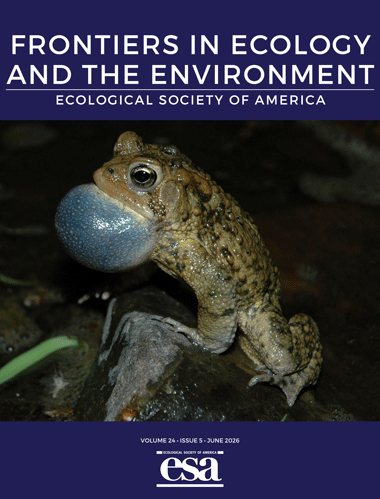
Frogs and toads—like the American toad (Anaxyrus [=Bufo] americanus) shown on the cover of the June issue of Frontiers—are ectotherms and attract mates using breeding calls. After recording the breeding calls of male frogs held at different temperatures, scientists showed that certain call characteristics, such as call duration and calling rate, not only affect male attractiveness to females but also are affected by temperature. In the June issue of Frontiers, Pekny et al. propose that, as a result, females may track temperature-dependent call characteristics to best time their arrival at breeding grounds where reproduction is constrained by temperature. The authors also provide further discussion and suggest tests of this hypothesis that may yield novel insights into amphibian reproduction and possibly uncover one of the mechanisms that allows frogs and toads to track changing climate more rapidly than most other organisms to date.
-
Ecosphere

Red gorgonians (Paramuricea clavata) and black corals (Antipathella subpinnata) form dense animal forests on mesophotic reefs (40–100 m) of the Aegean Sea, as illustrated in the photo on the cover of the June issue of Ecosphere. The diversity and distinctiveness of fish communities found in these mesophotic animal forests were investigated through visual census and collection of cryptic species by rebreather divers. In their paper in the May issue of Ecosphere, Jacquemont et al. show that these habitats support a higher abundance and richness of fishes that formed communities ecologically distinct from those found on shallower reefs or on mesophotic barrens. However, these communities were impacted by fishing activities, notably through the accumulation of abandoned fishing gear. These findings call for dedicated management and conservation policies to safeguard these rich but fragile ecosystems.
-
Ecology
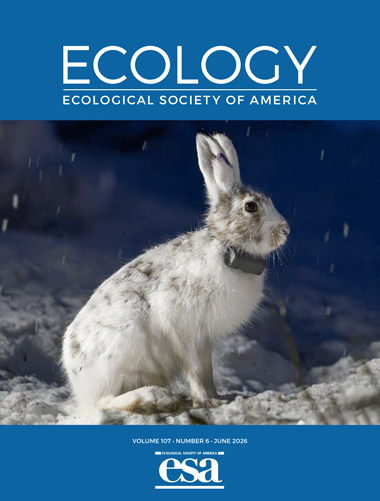
The cover of the June issue of Ecology features a GPS-collared adult male mountain hare (Lepus timidus) photographed on April 12th, 2026 at a trapping site in Brumunddal Municipality, Norway—one of the study sites of the HareKlima project. In their The Scientific Naturalist contribution published in the May issue of Ecology, Pedersen et al. document an unsuspected long-distance dispersal event of a subadult male mountain hare (59 km straight-line distance) that occurred in January 2025. Such events may be infrequent but challenge our current perception of the dispersal capacity of mountain hares and other smaller-bodied mammal species. These dispersal events may prove important for gene flow and recolonization after local population extinctions.
-
Ecological Monographs
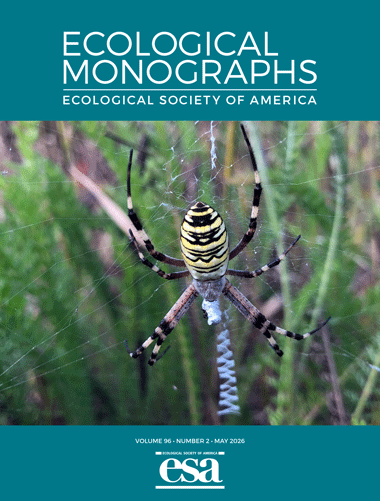
A thorough understanding of the impacts of climate change on species requires integrating multiple lines of evidence across adult and juvenile stages. Although spiders are significant generalist predators, their responses to novel environments remain understudied. The study by Sheffer et al. in the February issue of Ecological Monographs focuses on the wasp spider, Argiope bruennichi, which has expanded its range northward in Europe over the course of just a few decades. The authors find that northern populations have diverged from southern populations through a combination of genetic and plastic responses resulting in accelerated development, smaller body sizes, and physiological adaptations in offspring that enhance low-temperature survival. The May cover image shows a female A. bruennichi on her web.
-
Ecological Applications
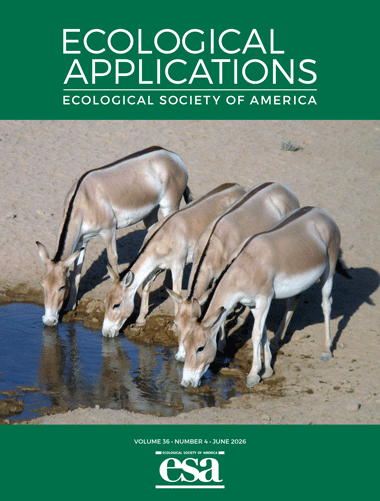
Resource distribution shapes interactions in wild populations by affecting movement, space-use patterns, and mating systems, potentially limiting encounters between breeders and reducing the number of individuals contributing to the population’s gene pool. In their article in the April issue of Ecological Applications, Kan-Lingwood et al. demonstrated how the distribution of water resources can influence mating patterns and genetic diversity in the endangered Asiatic wild ass (Equus hemionus) population in the Negev Highlands, Israel. Following the addition of new artificial water sources in 2020, the number of reproducing males and the variance effective population size increased, highlighting how adaptive resource management can support long-term population resilience and genetic diversity. The June cover image shows Asiatic wild asses drinking from the single artificial water source that supplied water to the population before the water management intervention.
-
The Bulletin
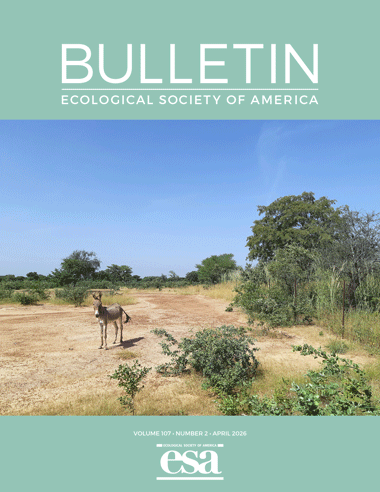
The April issue of the ESA Bulletin highlights resources for ecological education, including an approach that combines acoustic bird monitoring with music-making, conveys the importance of environmental justice and traditional ecological knowledge (TEK), and shares society actions and summaries from regional meetings and ESA's annual meeting. The cover image depicts a donkey beside a grazing exclusion where vegetation has naturally recovered, illustrating ecological change.
-
Earth Stewardship

We are delighted to announce a call for submissions for Earth Stewardship. This exciting new Open Access journal, launched with our publishing partner, John Wiley & Sons, calls for a broad spectrum of scientifically and technologically innovative and groundbreaking contributions including cross-cultural perspectives from leading researchers, policymakers, traditional custodians of land and sea and indigenous communities. Earth Stewardship publishes applied and theoretical articles to promote a broad, intercultural, and participatory foundation for earth stewardship.

2026 Annual Meeting
Are you already thinking about our next meeting? Are you interested in submission types, deadlines, location, travel options and dates? Select the following link and to go to www.esa.org/saltlake2026/
Read more
ECOLOG-L
Access our long-standing email Listserv. Topics in the field of ecology include, research updates, news, job opportunities and more. A free subscription to the list serve allows you to choose what content you want delivered to you and how often.
Read more
Opportunity Fund Donations
Make a difference and fund programs which empower, educate and embolden both the current and next generation of scientists in the vast field of ecology.
Read more